
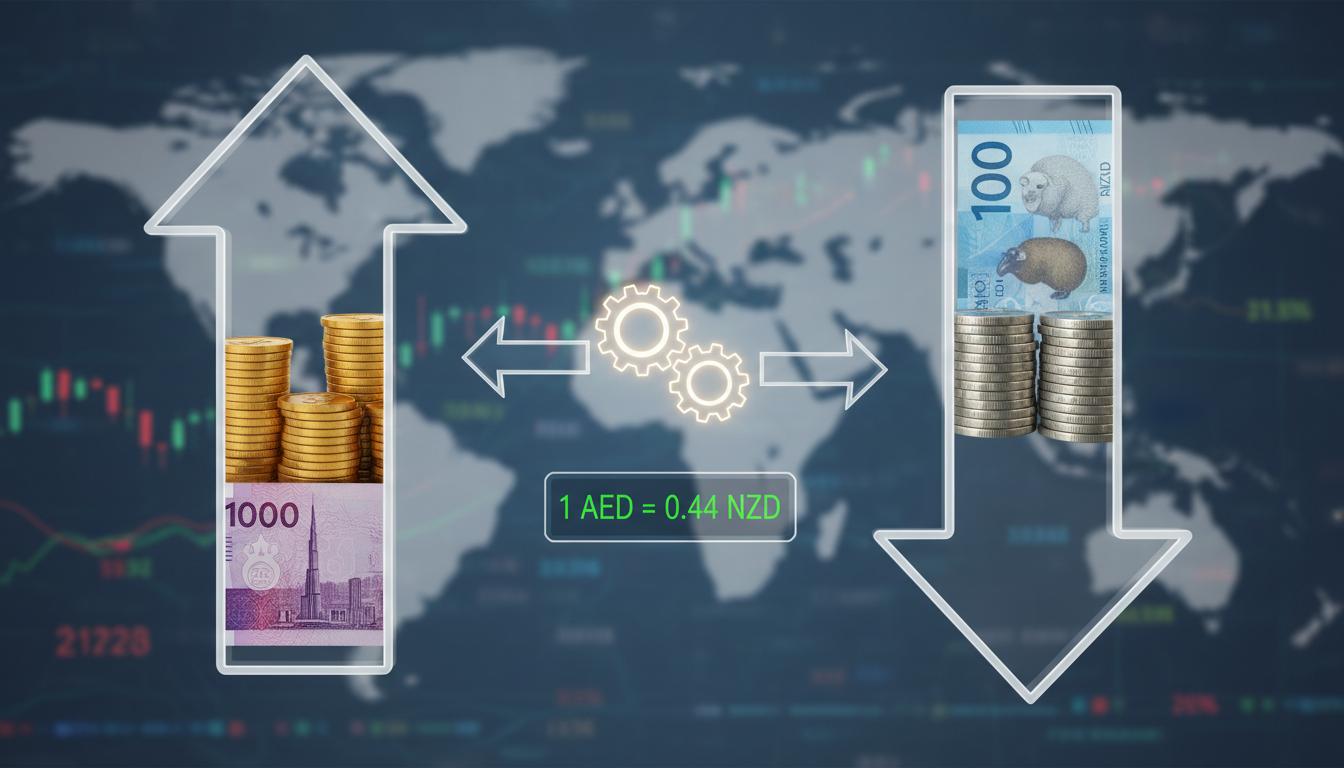
Converting AED to NZD seems simple until fees, rate markups, and timing get in the way. If you’re moving money between the UAE and New Zealand, paying for a trip, or getting paid in dirhams, a little know‑how can save you real money. This guide explains how the AED to NZD exchange rate works, the cheapest ways to convert, and the traps to avoid.
What is
AED is the United Arab Emirates dirham. NZD is the New Zealand dollar. When you see AED to NZD, it means how many New Zealand dollars one dirham buys.
The UAE dirham (AED) is effectively fixed to the US dollar. The long‑standing peg is 3.6725 AED per 1 USD. The New Zealand dollar (NZD) floats, so its value moves with interest rate expectations, global risk appetite, and commodity trends.
Because AED tracks USD, the AED to NZD rate mostly follows USD to NZD. If USD gets stronger against NZD, AED usually does too. If USD weakens against NZD, AED typically falls with it.
There is a “mid‑market rate,” sometimes called the interbank rate. It’s the midpoint between buy and sell prices you see on financial data sites. Most banks and money changers add a margin on top of this rate and may charge extra fees. Your real AED to NZD rate is often the mid‑market rate minus a markup.
Notation matters. AED/NZD shows dirhams priced in New Zealand dollars. NZD/AED is the inverse. If AED/NZD is 0.45, then NZD/AED is 1 ÷ 0.45 ≈ 2.22.
How it works
The peg drives the mechanics. One dirham equals roughly 0.2723 US dollars because 1 ÷ 3.6725 ≈ 0.2723. To estimate AED to NZD, take the USD to NZD rate and multiply by 0.2723. Put simply: AED to NZD rises and falls with USD to NZD.
What you actually receive depends on:
- Exchange rate margin: The hidden spread compared to the mid‑market rate.
- Fees: Flat transfer fees, card international fees, or ATM charges.
- Method: Bank transfer, card payment, ATM withdrawal, or cash exchange all price differently.
- Timing: Providers often widen spreads on weekends or when markets are closed.
New Zealand banks, UAE banks, online money transfer services, and currency exchanges all quote their own AED to NZD price. Two providers can differ by several percent on the same day. On larger amounts, that gap stings.
Types / examples
You can convert AED to NZD in a few main ways, each with distinct costs and use cases.
Cash exchange
Swap AED banknotes for NZD at a money changer or bank branch. It’s straightforward for small sums but often the priciest due to wide spreads. Airport kiosks are convenient yet typically the worst value.
Card payments
Pay with a debit or credit card. If you choose to be charged in NZD at a foreign terminal, you may trigger dynamic currency conversion (DCC), which applies a poor rate. Always choose to pay in the local currency of the country you’re in and let your bank handle the AED to NZD conversion. Check your card’s foreign transaction fee first.
ATM withdrawals
Using ATMs abroad can be cost‑effective if your bank offers fair rates and low fees. Decline DCC at the ATM. There may be local ATM fees plus your bank’s international fee.
Bank transfers
Straight bank‑to‑bank transfers are familiar but can carry higher margins and SWIFT fees. Good for reliability, not always for price.
Online money transfer services
Specialist providers often use the mid‑market rate with a clear fee, or tighter spreads than banks. Transfers are tracked in apps, and delivery can be fast. Suited to sending AED to NZD for family support, invoices, or personal moves.
Multi‑currency accounts
Some services let you hold AED, convert to NZD at sharp rates, and spend or withdraw. Handy for frequent movers between the UAE and New Zealand or for freelancers dealing in both currencies.
Worked examples (for illustration)
- Card spend: Pay AED 1,000 in the UAE. Your bank converts at its AED to NZD rate. If the mid‑market AED to NZD is X and your bank’s margin is 2%, you effectively receive X × 0.98 per AED, minus any card fee.
- Transfer: Send AED 5,000 to a New Zealand account. Provider A charges the mid‑market rate plus a NZD 5 fee. Provider B uses a rate 3% worse with no fee. Provider A is usually cheaper overall.
Pros and cons
Pros of dealing with AED to NZD
- Relative stability on the AED side thanks to the USD peg, which simplifies planning.
- Plenty of conversion channels: banks, online platforms, ATMs, and travel cards.
- Transparent pricing available if you choose mid‑market‑based services.
Cons to watch
- NZD volatility can move your AED to NZD total quickly, especially around Reserve Bank of New Zealand decisions or major data releases.
- Hidden spreads and DCC can quietly add 3%–7% to costs.
- Weekend and holiday markups; smaller providers may also cap transfer sizes.
How to use or choose
Here’s a quick, practical path to a fair AED to NZD conversion.
- Check the mid‑market rate. Look it up on a trusted source and note the live AED to NZD figure.
- Compare providers. Get a real quote from your bank and two online services for the same amount.
- Calculate total cost. Include transfer fees, card fees, and the rate margin. Focus on the NZD received.
- Avoid DCC. When paying or withdrawing, choose to be charged in the local currency, not NZD.
- Time it if you can. Avoid weekends; consider setting a rate alert if your transfer is flexible.
- Send a small test. For large sums, do a trial transaction to confirm speed and details.
- Lock and track. Confirm recipient details, lock the rate if offered, and track delivery to the NZ account.
Comparison of common AED to NZD options
| Method | Typical fee structure | Exchange rate margin | Speed | Best for | Key risk |
|---|---|---|---|---|---|
| NZ bank transfer | Flat SWIFT fee + margin | Often 2%–4% | 1–3 business days | Reliability, large sums | Higher total cost |
| Online money transfer service | Low flat fee or none | Mid‑market or ~0.3%–1% | Minutes to 1–2 days | Everyday transfers, value | Provider limits on amounts |
| Cash exchange (city) | Built into rate | 3%–7%+ | Instant | Small cash needs | Counterfeit risk; poor rates |
| Airport kiosk | Built into rate + fees | Highest | Instant | Last‑minute cash | Worst value |
| Debit/credit card spend | Foreign fee 0%–3% | Network rate + bank margin | Instant | Everyday purchases | DCC prompts at terminals |
| ATM withdrawal | Local ATM + bank fee | Network rate + bank margin | Instant | Cash on the go | High fees if unplanned |
Choosing the right path
- Under NZD 1,000: Online transfer services or a low‑fee card usually beat banks.
- NZD 1,000–10,000: Compare at least three quotes; small margins matter here.
- Over NZD 10,000: Consider providers with tiered pricing or an FX broker; ask about rate locks.
- Frequent conversions: A multi‑currency account can reduce repeated fees.
Tactics to reduce costs
- Always benchmark against the mid‑market AED to NZD rate before you commit.
- Decline DCC at shops and ATMs; let your bank or network convert.
- Avoid weekend conversions when spreads widen.
- Bundle transfers if fees are flat, but don’t risk bad timing for tiny savings.
- Keep beneficiary details exact to avoid recall fees and delays.
FAQ
Is AED fixed in value?
The UAE dirham is effectively pegged to the US dollar at 3.6725 AED per USD. That peg has been stable for decades.
Why does AED to NZD move if AED is pegged?
Because NZD floats. When the US dollar strengthens or weakens versus the New Zealand dollar, AED typically moves the same way against NZD.
What’s the mid‑market AED to NZD rate?
It’s the fairest real‑time benchmark used between banks. You can see it on financial news sites and currency trackers. Most retail providers add a margin to it.
What affects the NZD side?
Reserve Bank of New Zealand interest rate decisions, inflation data, global risk sentiment, commodity prices, and China’s growth outlook often influence NZD.
What’s the cheapest way to convert AED to NZD?
There’s no single winner every day, but specialist online transfer services are often cheapest thanks to tight spreads and transparent fees. Always compare against your bank’s quote.
How do I avoid bad rates when paying by card?
When a terminal asks which currency to charge, select the local currency of the country you’re in. Decline dynamic currency conversion. Check your card’s foreign fee before you travel.
Are airport exchanges really that bad?
Usually, yes. They rely on convenience and set wide margins. If you must, change a small amount only and do the rest in the city or via ATMs/cards.
Can I time the market?
If your transfer is flexible, avoid weekends and watch major NZ data releases. For large amounts, consider splitting transfers or using a rate alert. No one nails the top or bottom consistently.
How do I calculate what I’ll get?
NZD received equals AED amount multiplied by the provider’s AED to NZD rate, minus any fees. Compare this to the mid‑market calculation to see the total cost.
Is AED accepted in New Zealand?
No. You’ll need to convert to NZD before paying in stores or depositing to a New Zealand account.
Can businesses hedge AED to NZD exposure?
Yes. FX providers and banks offer forwards and limit orders. Hedging can stabilise cash flows if you invoice or get paid in AED while your costs are in NZD.
Do transfers get delayed on weekends?
Markets are closed, spreads widen, and bank processing pauses. Initiate transfers early on business days for faster delivery and better pricing.
Final tips for New Zealanders converting AED to NZD
Always start with the live mid‑market AED to NZD rate. Compare at least two providers. Avoid DCC, skip airport exchanges, and don’t send large amounts without a quick test. With a few smart choices, you’ll keep more of your money on its way from the UAE to New Zealand.