
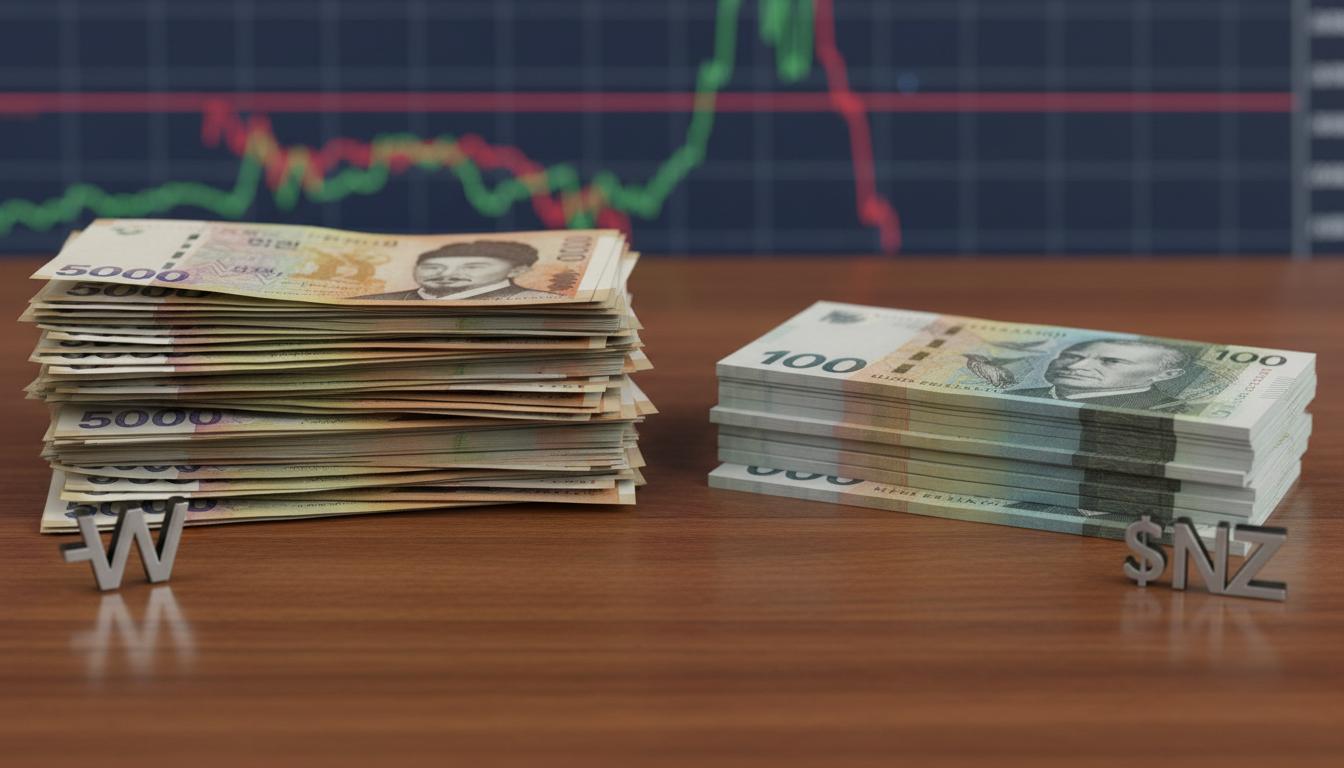
Whether you’re flying home from Seoul with cash in your wallet, paying a supplier in Busan, or planning a K-pop-fuelled shopping spree, understanding won to NZD puts money back in your pocket. Small differences in exchange rates and fees can cost more than a decent meal in Auckland. Here’s a clear, practical guide to how the KRW to NZD exchange rate works, the cheapest ways to convert, and how to avoid common traps.
What is
Won to NZD is the exchange rate between the South Korean won (KRW) and the New Zealand dollar (NZD). It tells you how many New Zealand dollars you’ll get for each won, or how many won you need for one New Zealand dollar.
Two common ways to quote the rate:
- Direct for a Kiwi: NZD/KRW. Example: 850 KRW per 1 NZD.
- Inverse: KRW/NZD. Example: 1,000 KRW equals 1.18 NZD.
Mid-market rate (also called the interbank or real exchange rate) is the midpoint between the buy and sell prices quoted on global markets. Most currency calculators show this number. Retail providers then add a margin on top, plus fees.
Basic formulas to keep handy:
- Converting won to NZD: NZD received = KRW amount ÷ (KRW per 1 NZD)
- Converting NZD to KRW: KRW received = NZD amount × (KRW per 1 NZD)
How it works
The KRW to NZD exchange rate moves with supply and demand in the global forex market. It changes through the day as traders absorb news and flows. Several forces push it around:
- Interest rates: Policy shifts by the Bank of Korea or the Reserve Bank of New Zealand can lift or sink each currency.
- Economic data: GDP, inflation, jobs figures, and trade balances matter. New Zealand’s dairy and commodity prices often sway NZD. Korea’s export cycle and tech sector cycle influence KRW.
- Risk sentiment: In times of global stress, investors may reduce exposure to smaller currencies, moving the rate quickly.
- Central bank guidance: Hints about future policy can shift expectations and, with them, the rate.
When you convert won to NZD, your total cost is shaped by:
- Exchange-rate margin: The difference between the provider’s rate and the mid-market rate.
- Fees: Flat fees, percentage fees, card international fees, ATM owner charges.
- Timing: Rates can change minute to minute; weekend and after-hours markups are common.
- Method: Cash exchange, card spending, bank transfer, or online money transfer can all price differently.
Types / examples
1) Cash exchange
Swap Korean won notes for New Zealand dollars at a bureau de change or bank. It’s simple, but spreads are usually the largest.
Example: You bring back ₩500,000. The mid-market suggests you could get NZ$590, but the kiosk rate yields NZ$540 after fees. That NZ$50 gap is the margin and fee combined.
2) Card spending in Korea
Using a NZD credit or debit card in South Korea converts NZD to KRW at the card network rate, often close to mid-market, plus any bank international fees (often 1–3%). Decline “dynamic currency conversion” (DCC) at the terminal; always pay in KRW for a better won to NZD outcome.
Example: A ₩100,000 dinner charged in KRW clears at near the network rate; your bank adds a 2% foreign fee. Paying in NZD via DCC could cost 4–8% more.
3) ATM withdrawal in Korea
Withdraw KRW using a NZ card. Network rates are decent, but there may be NZ bank international/ATM fees and a local ATM operator fee. Again, avoid DCC if prompted.
4) Bank transfer KRW ↔ NZD
Sending money from Korea to New Zealand or vice versa usually means a bank’s exchange-rate margin plus a sending fee. Intermediary banks can also skim charges on SWIFT transfers.
Example: A KRW account sends the equivalent of NZ$5,000 to a NZD account. The bank’s rate is 3% off mid-market and fees total NZ$30. Total cost: roughly NZ$180.
5) Online money transfer services
Specialist providers often use sharper rates (close to mid-market) and transparent fees. Transfers can be fast, especially to NZ bank accounts, though speed varies by corridors and compliance checks.
Example: Converting won to NZD for tuition: the provider charges a 0.6% margin and NZ$5 fee. On NZ$5,000 equivalent, you might save over NZ$100 compared to a standard bank.
6) Multi-currency account or card
Hold KRW and NZD balances, convert when the rate looks good, then spend or transfer. Useful if you receive income in KRW and spend in NZD (or the other way around).
7) Business hedging tools
Forward contracts lock a future KRW/NZD rate for invoices or payroll. Limit orders trigger conversions at your target rate. These tools reduce uncertainty but can have requirements or fees.
Pros and cons
Cash exchange
- Pros: Immediate, no bank account needed, private.
- Cons: Highest margins, safety risk carrying cash, limited by branch stock.
Card spending and ATMs
- Pros: Convenient, network rates are competitive, good for travel.
- Cons: Bank foreign fees, ATM operator fees, DCC traps at terminals.
Bank transfers
- Pros: Familiar, direct to bank accounts, strong security.
- Cons: Wider spreads, multiple bank fees, slower if intermediaries involved.
Online money transfers
- Pros: Lower margins, clear pricing, fast settlement in many cases.
- Cons: Verification required, limits for new users, speed can vary by corridor.
Multi-currency accounts and hedging
- Pros: Flexibility, potential to convert at better times, budgeting by currency.
- Cons: Not all support KRW fully, account fees may apply, learning curve for forwards.
How to use or choose
Step-by-step: Converting won to NZD at the best total cost
- Check the mid-market KRW/NZD rate on a reputable currency tracker. This is your benchmark.
- List 3–4 providers: your NZ bank, an online transfer service, a major money exchange, and (if relevant) your card network rate plus bank fees.
- Get all-in quotes: the offered rate, the explicit fees, and any receiving/ATM fees. Convert each to a total NZD received (or total KRW paid).
- Avoid dynamic currency conversion: if paying or withdrawing in Korea, choose KRW on the terminal or ATM.
- Match the method to the job: cash for small leftover amounts, online transfer for larger sums, card for day-to-day spending.
- Time it if you can: rates can move; if you’re flexible, set alerts near your target won to NZD level.
- Verify recipient details: for bank transfers, confirm names, account numbers, and bank codes to avoid return fees.
- Keep records: screenshots of quotes and receipts help if you need to query charges.
What to look for when choosing a provider
- Transparent pricing: clear rate and fees, not “no fee” with a steep margin.
- Regulation and security: licensed in New Zealand and in the sending jurisdiction; strong customer support.
- Speed and delivery: how long to land NZD? Are there cutoff times or weekend delays?
- Limits and verification: ID checks, per-transfer caps, and cumulative limits.
- Payment options: bank transfer, card, cash pickup (if relevant), and supported currencies (KRW and NZD both ways).
Quick tips to improve your KRW to NZD rate
- Compare at least two options against the mid-market rate before committing.
- Avoid airport kiosks unless it’s an emergency.
- Decline DCC and pay in the local currency when abroad.
- Batch transfers when sensible to reduce flat fees.
- Set rate alerts; consider converting in smaller tranches if volatility is high.
Comparison: ways New Zealanders convert won to NZD
| Method | Typical FX margin vs mid-market | Fees | Speed | Convenience | Best for |
|---|---|---|---|---|---|
| Airport/bureau cash exchange | High (often 5–12%) | May add flat fee | Instant | Walk-up | Small cash conversions only |
| NZ bank counter or online | Moderate to high (often 2–5%) | Possible transfer fee | 1–3 business days (transfer); instant for cash in stock | Trusted, direct to account | Larger bank-to-bank transfers |
| Online money transfer service | Low to moderate (often 0.3–1.2%) | Transparent flat/percent fee | Minutes to 1–2 business days | Mobile/web, easy to compare | Most personal and SME payments |
| Card spending in Korea (pay in KRW) | Low (near network rate) | Issuer foreign fee 0–3% | Instant authorisation | Very convenient | Travel purchases |
| ATM withdrawal in Korea (in KRW) | Low (near network rate) | NZ bank + local ATM fee | Instant cash | Widespread ATMs | Cash access while travelling |
| Card or ATM with DCC (charged in NZD) | High (hidden at terminal) | May add fees too | Instant | Offered by merchants | Avoid—usually costly |
FAQ
What is the best way to convert won to NZD?
For everyday travel spending, pay in KRW with your card and decline DCC. For larger transfers, compare your NZ bank’s quote with at least one specialist online transfer service and choose the best all-in cost (rate plus fees).
Is it cheaper to exchange KRW to NZD in New Zealand or in Korea?
It depends on the provider, not the country. Airport kiosks in both places tend to be expensive. If you still have KRW cash when you’re back in NZ, compare a few city bureaus or consider depositing to a bank that accepts KRW (availability varies) and converting via transfer.
How can I calculate what I’ll receive in NZD?
Use: NZD = KRW ÷ (KRW per 1 NZD at your provider). Compare that with the mid-market to see the margin. Always include any flat fees in your total.
Why is my bank’s won to NZD rate different from online quotes?
Banks often add a wider margin and may update rates less frequently. Online platforms usually show the mid-market rate and then add a smaller, disclosed fee. Timing and liquidity also matter.
What affects the KRW/NZD rate day to day?
Interest-rate expectations, inflation data, trade numbers, commodity prices, and global risk appetite. Central bank statements from the Bank of Korea and the Reserve Bank of New Zealand can move the market.
Are weekend exchange rates worse?
Often, yes. Many providers widen spreads on weekends and holidays when markets are thin. If possible, convert on a business day during market hours.
How do I avoid dynamic currency conversion (DCC)?
At checkout or the ATM, if offered a choice to be charged in NZD or KRW, select KRW. DCC adds a poor rate. Your bank will handle the conversion at a better network rate.
Can I lock in a future rate for business invoices?
Yes. Ask about forward contracts or limit orders with your bank or a regulated FX specialist. These tools can stabilise costs for predictable KRW or NZD cashflows.
What documents do I need for a transfer?
Expect standard ID (passport or driver licence), proof of address, and sometimes source-of-funds documents for larger amounts. These checks are required under anti-money laundering rules.
What’s the safest way to send money from Korea to New Zealand?
Use regulated banks or licensed money transfer providers. Double-check recipient details, avoid public Wi‑Fi when setting up transfers, and keep confirmation records.
What if I need NZD urgently?
For immediate cash, use a reputable city bureau or your bank if they hold NZD on hand. For transfers, some online services offer near‑instant payouts to NZD accounts during banking hours, but fees may be higher for speed.
How can I track a good won to NZD level?
Set alerts on a currency app for NZD/KRW. If you have flexibility, convert in stages as the rate improves instead of all at once.
Is there a limit to how much KRW I can bring to New Zealand?
You can bring in any amount of currency, but you must complete a Border Cash Report if you carry NZ$10,000 equivalent or more in cash. Rules can change; check official guidance before you travel.
Bottom line
To get more from your won to NZD conversion, benchmark against the mid-market rate, compare a couple of providers, and watch for hidden costs like DCC and intermediary bank fees. Pick the right method for the job—card for daily spending, online services for most transfers, and cash only when necessary. A few careful choices can turn a forgettable rate into real savings in your New Zealand bank account.